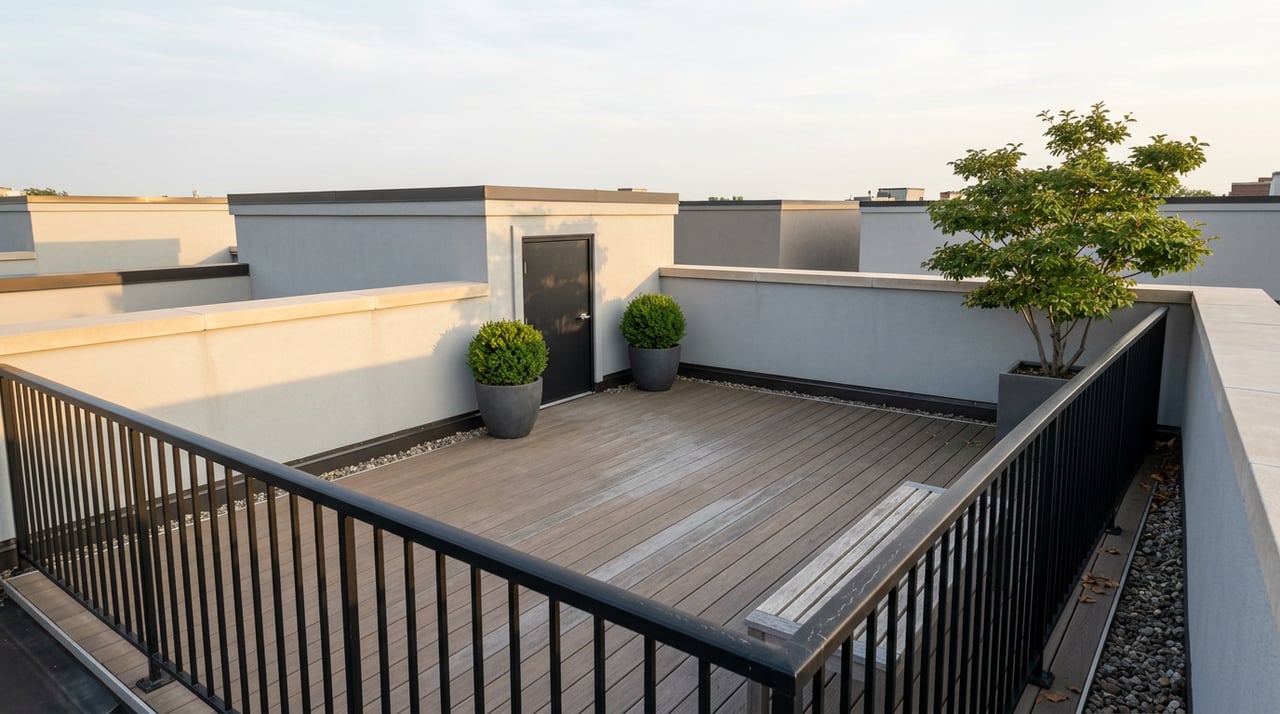
Ask a handful of Fishtown owners what stands between them and a legal roof deck, and most will guess the same thing: the Historical Commission. It's a reasonable guess. This is a neighborhood full of century-old brick rowhomes, and everyone has heard a story about a renovation getting tangled up in preservation review somewhere in Philadelphia.
It's also, for nearly every block in the neighborhood, the wrong guess. The real obstacle sits somewhere else, in a distinction the city's own permit system draws between a deck and a roof deck, and in what happens the moment an inspector finds one that was built without paperwork. That distinction is why Fishtown's current roof deck premium, which is real and measurable, isn't equally available to every owner who has one.
A Market That Rewards Outdoor Space More Than It Used To
Fishtown's housing market cooled slightly over the past year. In the three months ending June 2026, the median sale price came in around $444,000, down 3.2% compared to the same period the year before. Homes sold in an average of 38 days, up from 35 the previous year, and 72 homes closed in June, down from 80. None of that describes a market in freefall. It describes a market where buyers are taking a little more time and paying a little less on average than they were a year earlier.
That kind of slowdown changes what wins inside it. A local review of 2025 and 2026 sales activity in Fishtown pointed to outdoor space, roof decks, and remaining years on a tax abatement as the features that separated homes selling quickly at a premium from homes that sat. In a market where the average listing takes three more days to find a buyer than it did the year before, buyers have both the time and the standing to be selective. A finished, properly documented roof deck is one of the few things still cutting through that hesitation.
Which means the premium is now concentrated in a feature that depends entirely on something most owners have never checked closely: whether the deck is permitted the way the city actually requires, not the way most people assume it is.
Where Everyone Assumes the Fight Is
The Philadelphia Historical Commission has designated 37 properties across all of Fishtown, and many of those are contiguous rowhomes counted individually, including nine homes on a single block of East Berks Street. Even accounting for anything added since that count, the number is small enough that most Fishtown streets, including the busy stretch of Frankford Avenue between Girard and York where only one building carries individual designation, sit entirely outside historic review.
If a rowhome owner is bracing for the Commission to slow down a roof deck application, that worry is misplaced for nearly every property in the neighborhood. The actual bottleneck runs through the Department of Licenses and Inspections, and it looks nothing like historic preservation review.
The Permit That Was Never Built for This
The City of Philadelphia offers a fast, plans-free path for a simple deck called an EZ Permit. It's limited to ground-level decks in the rear yard, capped at 216 square feet, with no roof or wall enclosure allowed and no location above the first floor. A roof deck fails every part of that description by definition, which means it's excluded from the EZ path entirely.
Because a roof deck adds new occupied space above the first floor, it triggers a slower, sequential process instead. According to Jane Draws Plans, a Zoning Permit has to be issued first, carrying a 15-day standard review, before a Building Permit application, with its own 21-day review, can move forward. Add a pilot house for roof access, and height and setback rules can come into play depending on exactly where that structure sits on the lot.
| Ground-level deck (EZ Permit) | Roof deck | |
|---|---|---|
| Location | Rear yard only | Above the first floor |
| Size limit | Up to 216 sq ft | Governed by zoning coverage rules |
| Plans required | None | Plans |
| Review sequence | Over the counter | Zoning Permit, then Building Permit |
| Structural review | Not required | Engineer evaluation of existing roof framing |
| Shared wall considerations | Rare | Party-wall impacts |
The Violation That Changes Everything
Here's the mechanism that catches people off guard. The Philadelphia Department of Licenses and Inspections says a project that receives a violation notice for work done without a permit loses eligibility for the EZ Permit shortcut permanently, even for scopes that would have otherwise qualified. Legalizing the work after that point means submitting full plans through the same review lanes as new construction, along with permit fees the city doubles once a violation is on the record.
This is where Fishtown's older housing stock adds real exposure. Most of these rowhomes were framed for a roof meant to shed water, not to hold people, furniture, and planters full of wet soil. An engineer looking at a roof built decades before anyone imagined a rooftop lounge chair will often call for sistered joists or added beams before signing off. Rowhomes also share party walls, so a deck project that touches roof continuity or drainage can require documentation of how the work affects the house next door, not just the one it sits on top of.
The Same Rules, Built In From the Start
New construction in Fishtown treats a roof deck as part of the original design rather than an afterthought. Permits issued for a three-story single-family rowhouse at 2025 Abigail Street include a basement and roof deck as part of the original filing, not an add-on. A permit for a three-story rowhouse at 2405 East Dauphin Street was filed the same way, with the roof deck built into the plans from the start.
Neither of these projects will ever face the EZ Permit question, because the deck was part of the building permit from day one. The exposure sits almost entirely with older homes, where a deck gets added years or decades after original construction, often by an owner who assumed a deck is a deck no matter where it sits.
What This Means If You're Buying
Before an inspection contingency runs out, ask the seller or listing agent for:
- Confirmation of whether the home carries individual historic designation or sits inside a historic district
- The Zoning Permit and Building Permit specific to the roof deck itself, not a general renovation permit that mentions it in passing
- A final inspection sign-off or Certificate of Approval showing the completed structure passed city inspection
- Stamped structural calculations if the roof required reinforcement
- Any documentation covering shared party wall or roof continuity, if the deck ties into an adjoining property
An online valuation tool can't see any of this. A public property record can show that a permit was filed without showing whether it was ever closed out, and a deck that looks finished from the street below can still be sitting on an open violation. None of that is a reason to walk away from a home with a roof deck. It's a reason to get the closed permit in hand before the contingency deadline passes.
What This Means If You're Selling
If a deck was built without going through the full sequence and has never triggered a violation, the better move is closing that gap voluntarily before listing rather than waiting for a buyer's inspector to find it. A self-reported legalization can still move through the standard process. A violation notice takes that option off the table and adds cost on top of delay.
Pull the permit history before the home goes on the market, not after an offer arrives. A lender's underwriter reviewing a file for a conventional loan or an FHA loan will ask the same questions a buyer's agent eventually will, and the strongest answer is a completed permit record, not an explanation over the phone.
FAQ
Does every Fishtown rowhome need a permit for a roof deck? Yes. City guidance is direct that any roof deck project needs, at minimum, a Zoning Permit and a Building Permit.
What if my rowhome sits in one of Fishtown's small pockets of historic designation? Historic status adds a review step with the Philadelphia Historical Commission before L&I can issue permits, so confirming status early avoids a delay stacked on top of the standard zoning and building review.
Can a violation on an unpermitted deck derail a sale already under contract? It can complicate one.
If you're weighing an offer on a Fishtown rowhome with a roof deck, or getting ready to list one, Conchetta Park works through exactly this kind of paperwork before it becomes a problem at the settlement table. Let's Connect.
This article is general information, not legal, tax or financial advice. Consult a qualified professional about your situation.